
Calf tears are a common injury we see in active people across Solihull, Birmingham and Sutton Coldfield, from runners and gym-goers to people who feel a sudden “ping” just walking the dog or hurrying for the bus. Although the injury can stop you in your tracks, most people recover well with the right assessment, sensible loading and a structured rehabilitation plan.
At Achieve Health, we help people understand what has happened, why it happened, and what to do next so they can get back to walking, training and daily life with confidence.
What is a calf tear?
Your calf is made up of powerful muscles at the back of your lower leg that help you walk, run, jump and push up onto your toes. A calf tear happens when some of those muscle fibres are overstretched or overloaded, usually during a sudden burst of speed, a push-off movement or a rapid change in direction.
People often describe it as feeling like being kicked or hit in the back of the leg. It may be followed by tightness, difficulty walking normally and bruising or swelling that becomes more obvious over the next day or two.
If the pain is affecting your ability to walk, hop or push off, it is worth getting assessed by a physiotherapist early rather than waiting for it to settle on its own.
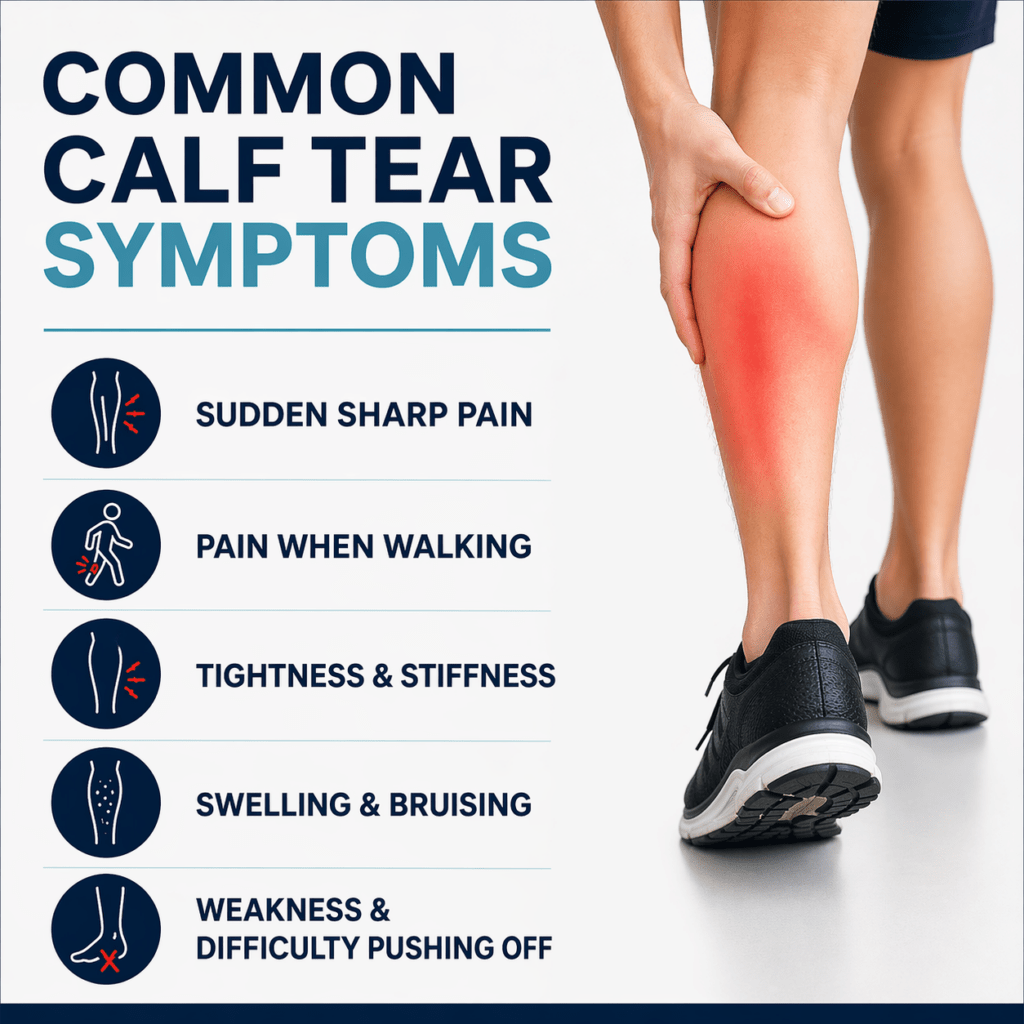
Although every injury is different, there are some typical signs that suggest a calf tear rather than simple tightness or cramp:
- A sudden sharp pain or “pull” in the back of the lower leg during sprinting, jumping, turning or pushing off.
- Pain when walking, especially when you first stand up or try to walk quickly.
- Tightness, stiffness or the feeling that the calf might “go again” if you push too hard.
- Tenderness when pressing into the muscle, sometimes with swelling or bruising over the following 24–48 hours.
- Difficulty going up on tiptoes, hopping, running or climbing stairs on the affected leg.
If these symptoms sound familiar, physiotherapy can help confirm what is going on and rule out other problems such as an Achilles tendon issue or referred pain from the back.
Why calf tears happen
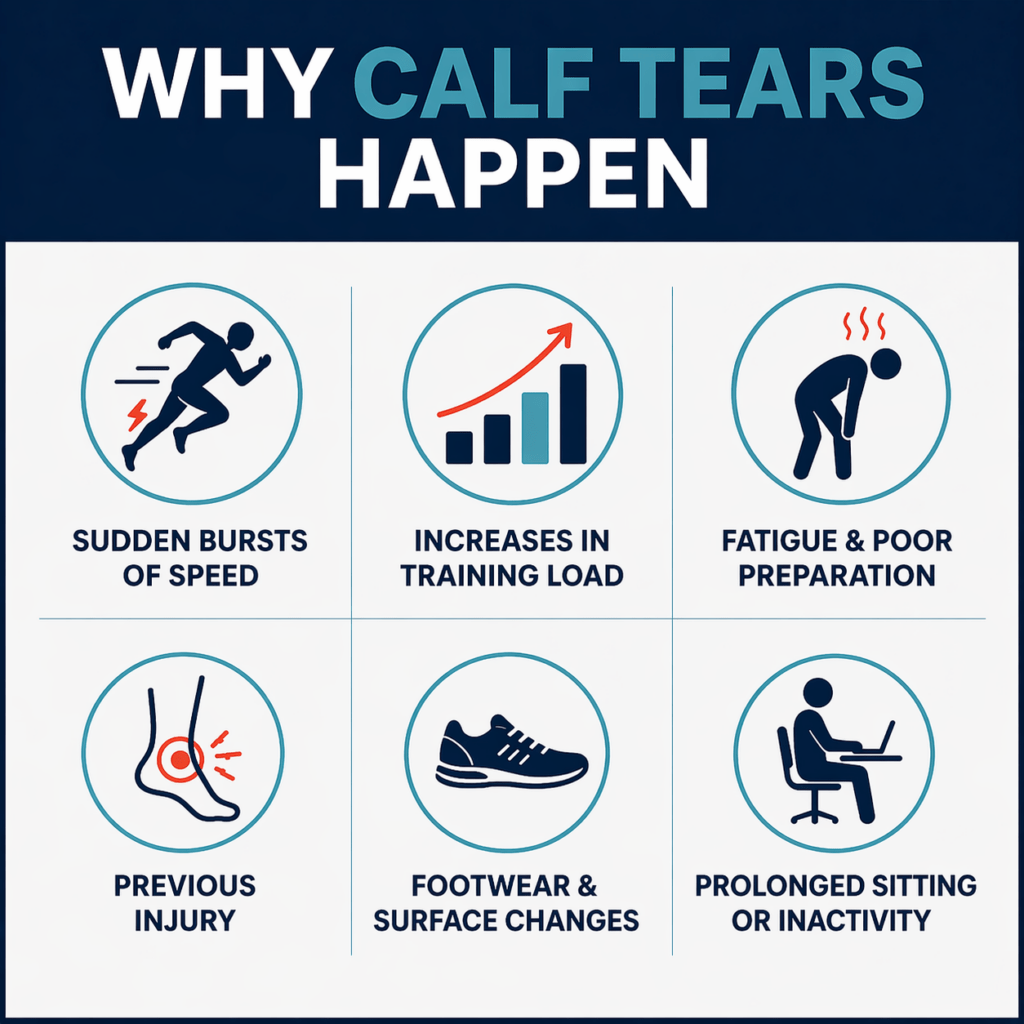
We usually see calf tears after a clear spike in load. That might be a sprint, a sudden acceleration, repeated hill running, a new gym class or returning to sport too quickly after time off. The calf is also more vulnerable when the body is tired, the warm-up has been poor or footwear and surfaces have changed.
Common triggers include:
- Sudden bursts of speed.
- Training increases that happen too quickly.
- Fatigue and poor preparation.
- Previous calf, ankle or Achilles problems.
- Changes in shoes, surfaces or running terrain.
Research in sports medicine highlights that calf strain injuries are strongly linked to load, fatigue and previous injury, and modern rehab guidance emphasises graded loading and a progressive return to running or sport.
When should you see a physiotherapist?
You do not need to wait until the pain becomes severe before seeing a physio. In fact, early assessment often speeds up recovery and gives you a much clearer plan.
Book an assessment if:
- You felt a clear “twinge,” pull or sharp pain in your calf and are now limping.
- Your calf pain is not improving after 7–10 days.
- You keep flaring it up when trying to walk faster, run or return to sport.
- You feel nervous about pushing off, changing direction or hopping.
- You have had more than one calf issue on the same side.
A physiotherapist can explain what has likely happened, what to expect over the coming weeks, and how to manage work, sport and daily life while you recover.
Simple self-care tips for calf pain
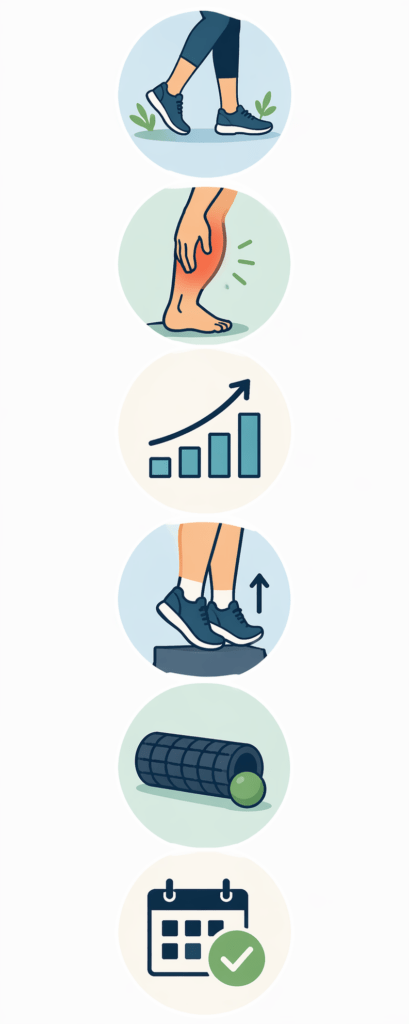
If the tear is mild and there are no red flags, these principles are often helpful:
- Stay gently mobile with short walks and regular position changes.
- Use pain as a guide; mild discomfort can be normal early on, but a big flare-up means you have likely done too much.
- Avoid sudden spikes in activity.
- Build back calf strength gradually rather than rushing straight back to full running or sport.
- Follow a progressive rehab plan rather than relying on rest alone.
Current rehab guidance supports a gradual loading approach, starting with lower-load, length-protected exercises and building towards heavier strengthening, plyometrics and return-to-running work as symptoms improve.
How Physiotherapy Helps
At Achieve Health, calf tear rehab is designed around the stage of the injury and the person in front of us. Early treatment may focus on pain control, walking tolerance and simple loading exercises. As the calf settles, the programme usually progresses into calf strengthening, balance, hopping, running drills and eventually full return to sport.
That process matters because calf injuries recover best when they are loaded well, not just rested. Well-structured rehab helps restore calf strength, tendon capacity and confidence, which reduces the risk of repeat injury.
Why choose Achieve Health?
At Achieve Health, we support runners, gym members, team-sport players and busy professionals across Solihull, Birmingham and Sutton Coldfield who want to recover properly and avoid repeat calf problems. Our physiotherapists use a movement-focused approach that combines clear explanation, progressive exercise and realistic return-to-sport planning.
When you come to us with a calf injury, you can expect:
- A clear explanation of what has happened.
- Advice that fits your sport, work and lifestyle.
- A straightforward rehab plan that is realistic and easy to follow.
- Support as you build back to walking, running and sport with confidence.
If you have recently felt that familiar “ping” in your calf, or you are stuck in a cycle of repeat twinges, our team at Achieve Health can help you take the next step.
Reference list
- British Journal of Sports Medicine. Calf muscle strain injuries in sport: a systematic review of risk factors for injury. Available from: https://bjsm.bmj.com/content/51/16/1189 [accessed 2026-04-17].
- PMC. Calf strains in athletes: a narrative review of management, injury mechanisms and return to play. Available from: https://pmc.ncbi.nlm.nih.gov/articles/PMC12701110/ [accessed 2026-04-17].
- RunningPhysio. Managing acute calf tears. Available from: https://www.running-physio.com/acutecalf/ [accessed 2026-04-17].
- Cleveland Clinic. Calf Strain (Pulled Calf Muscle): Treatment & Recovery. Available from: https://my.clevelandclinic.org/health/diseases/21558-pulled-calf-muscle [accessed 2026-04-17].
- YouTube. Calf Strain Rehab Exercises and Tests (Gastrocnemius or Soleus?). Available from: https://www.youtube.com/watch?v=y3zHHIP-iTU [accessed 2026-04-17].
- YouTube. The 7 BEST Calf Muscle Strain Recovery Exercises & Stretches! Available from: https://www.youtube.com/watch?v=k50hrc5Uadg [accessed 2026-04-17].